
Solomia Home operates the only Dubai showroom where Ceccotti Collezioni and Porada share the same floor. That arrangement is not a retail curiosity. It is a controlled study in what Italian hands do with a single plank of wood, presented by a team that can explain the difference between a mortise-and-tenon joint and a dowelled one, and why it matters after twenty years of daily use. With 17 years of modern interior design practice spanning residential villas, penthouses, and commercial spaces across the UAE, and back-to-back International Property Awards wins in 2024 and 2025, including Best Retail Interior Arabia and Best International Retail Interior, Solomia Home has built its reputation on material knowledge, not catalogue volume. The showroom stocks more than 25 Italian brands, from B&B Italia to Flexform to Poltrona Frau, but the Ceccotti-Porada pairing is where the conversation about solid wood begins and where most lacquered-MDF assumptions go to die.
Solomia Home and the Case for Material Literacy in Dubai
Located in Dubai Mall in the heart of Downtown, Solomia Home is an international interior design company specializing in architecture, interior and exterior design, construction, and furnishing of Italian-made furniture. The firm’s design division handles projects from initial concept through final installation, a turnkey model that gives its consultants control over every material specification in a given space. That control matters when the discussion turns to solid wood in a region where 40-45 degree Celsius exterior temperatures and aggressive air conditioning create an indoor humidity environment unlike any European factory floor.
The company’s portfolio of modern interior design work covers full-scale villa fitouts, apartment remodels, and commercial spaces. Solomia Home won Best Retail Interior Dubai at the Dubai Property Awards 2024-2025 for its design of the Versace Home showroom, then took both Best Retail Interior Arabia and Best International Retail Interior at the International Property Awards ceremony in London in February 2025. Those awards were judged by a panel of more than 50 international experts. The firm’s design innovation extends to material pairing: placing Ceccotti’s Renaissance-era joinery next to Porada’s modern sculptural forms in the same physical space forces a direct comparison that most furniture retailers avoid, because it requires staff who can speak fluently about wood species, finish chemistry, and joint mechanics rather than reciting catalogue copy.
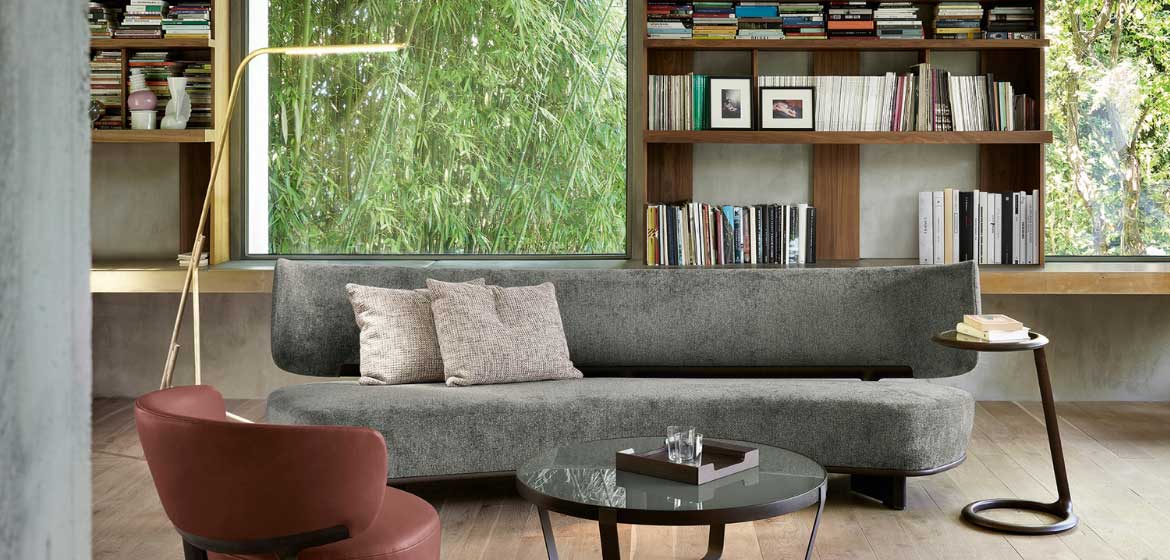
The diverse portfolio of brands at Solomia Home, from Henge to Rimadesio to Fendi Casa, serves a specific purpose: it allows the design team to compose interiors where solid wood coexists with glass, metal, stone, and upholstered forms. International recognition from the property awards circuit confirms what the showroom floor demonstrates: that Solomia Home treats furniture specification as a technical discipline, not a decorating exercise.
Ceccotti Collezioni: The Workshop in Cascina
Ceccotti Collezioni was founded in 1956 by Aviero Ceccotti in Cascina, a small Tuscan town between Florence and Pisa. The town has a documented tradition of woodworking tied to its local School of Art, which trained the carpenters who later formed the backbone of the company’s production staff. The company began as a residential furniture producer, then expanded into hotel supply contracts with Trusthouse Forte (London), Sheraton, and Ciga hotels before Franco Ceccotti, the founder’s son, launched the Ceccotti Collezioni brand in the late 1990s with designer Roberto Lazzeroni.
The factory works exclusively in solid wood. The primary species is American black walnut (Juglans nigra), sourced from SFI (Sustainable Forestry Initiative) and FSC (Forest Stewardship Council) certified plantations. No MDF substrate, no veneer overlay, no particleboard core appears in any Ceccotti product at any price point. This is a binary policy, not a marketing gradient. A Ceccotti bookcase and a Ceccotti desk share the same material specification: solid timber throughout.
Joinery: Mortise-and-Tenon, Hand-Cut Dovetail
Ceccotti’s production relies on two primary joint types. The mortise-and-tenon joint, where a projecting tenon on one component fits into a corresponding mortise cavity in another, is used for structural connections in tables, desks, chair frames, and cabinet carcasses. The hand-cut dovetail joint, where interlocking trapezoidal pins and tails resist tensile separation, appears in drawer construction and cabinet joinery. Both joint types are visible on many finished pieces rather than concealed, a deliberate decision that doubles as a quality guarantee: you can see the precision of the cut.
Comparative testing data supports the structural superiority of these methods. Research published in the journal Forests on mechanical properties of furniture joints found that mortise-and-tenon joints exhibit higher bending moment capacity than dowel-based alternatives, particularly when tenon shoulders are bonded and tolerances are tight. Practical workshop tests measured mortise-and-tenon joints averaging 172 pounds of failure load versus 135 pounds for three-dowel joints of equivalent dimensions, a margin of roughly 25% in raw shear strength. Over a 20-year service life that includes seasonal humidity cycling, thermal movement, and the repetitive stress of daily use, that 25% margin compounds: dowelled joints loosen as adhesive creeps and wood fibers compress around the dowel pins, while a properly fitted tenon maintains its mechanical interlock even if the glue line degrades partially.
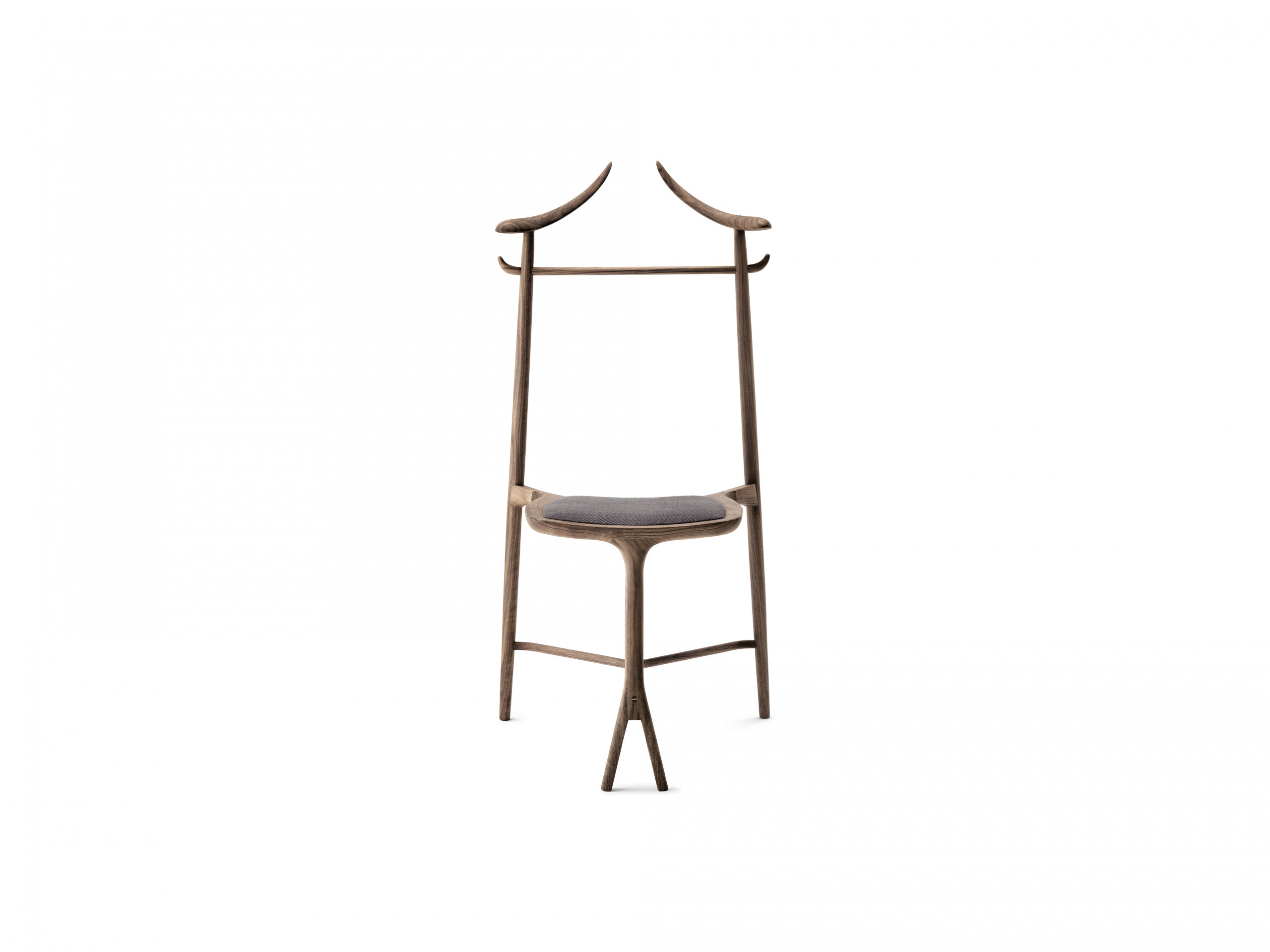
Ceccotti’s designers, including Roberto Lazzeroni, Jaime Hayon, Vincenzo De Cotiis, and Giuseppe Casarosa, work within these structural constraints. The Icosofà sofa frame, the Bean desk, the Star Trek armchair, the D.R.D.P. loveseat, all feature curves and organic forms that originate in bent solid walnut rather than laminated or veneered substrates. Production lead times of 5-9 weeks reflect the reality of working with a material that dictates its own schedule.
Porada: Wood Selection and the Modern Idiom
Porada was founded in 1968 by Luigi Allievi in Cabiate, in the Brianza furniture district near Lake Como, building on chair-making experience that dates to 1948. The company remains family-run, now operated by Allievi’s sons. Porada’s production vocabulary is broader than Ceccotti’s: the brand works in canaletto walnut (Juglans regia), ash, and Spessart oak, and combines solid wood with glass, metal, ceramic, and upholstery in ways that Ceccotti’s all-wood philosophy does not permit.
The ash used by Porada comes from certified forests. In 2011, the company purchased 220 hectares of certified forest land in Bourgogne, France, and has been replanting with grafted ash trees as mature timber is harvested. This direct ownership of forestland shortens the supply chain and gives Porada control over the drying and seasoning timeline. Logs are transported to Italy, cut into slabs, and air-dried overhead in the Cabiate factory for approximately one year before entering production. Slabs that develop defects during drying are diverted to the factory’s furnace; combined with rooftop solar panels, this wood waste fuels the entire production facility. Porada operates a self-powered factory.
Finish Processes: Ceccotti vs. Porada
The two houses take different approaches to surface treatment. Ceccotti’s American walnut typically receives an oil-based or wax finish that remains close to the wood surface and allows the grain texture to remain tactile. The color deepens over time as the walnut’s natural tannins oxidize, shifting from a lighter brown toward a richer chocolate tone over 10-20 years. Porada’s canaletto walnut finishes include both open-pore and closed-pore lacquer options, as well as a range of stained ash finishes (moka, wenge-stained, natural). The closed-pore option yields a smoother surface with less grain texture; the open-pore variant preserves tactile grain feel while still providing a lacquer seal against moisture exchange.
| Parameter | Ceccotti Collezioni | Porada |
|---|---|---|
| Founded | 1956, Cascina (Tuscany) | 1968, Cabiate (Brianza, Lombardy) |
| Primary Wood Species | American black walnut (Juglans nigra) | Canaletto walnut (Juglans regia), ash (Fraxinus), Spessart oak |
| MDF / Veneer Use | None, at any price point | None in wood structural components; glass/ceramic/metal in tops |
| Primary Joinery | Mortise-and-tenon, hand-cut dovetail | Mortise-and-tenon, CNC-assisted with hand finishing |
| Finish Type | Oil / wax, tactile grain preserved | Open-pore and closed-pore lacquer, multiple stain options |
| Forest Certification | SFI and FSC certified suppliers | 220 hectares owned forest (Bourgogne, France), FSC chain |
| Production Lead Time | 5-9 weeks | 6-8 weeks |
| Factory Energy | Not disclosed | Self-powered (wood waste + solar) |
| Janka Hardness (primary species) | 1,010 lbf (American walnut) | 1,320 lbf (ash); walnut comparable to Ceccotti |
| Volumetric Shrinkage (green to oven-dry) | 12.8% (American walnut) | 13.3% (white ash); walnut ~12.8% |
How Solid Wood Behaves in Dubai’s Climate-Controlled Interiors
The standard objection to solid wood furniture in the Gulf runs like this: Dubai’s exterior climate is too extreme, and the wood will crack. The objection misunderstands where the furniture actually lives. A solid-wood dining table in a Dubai villa does not experience the 45-degree Celsius exterior heat or the 70-90% coastal nighttime relative humidity. It experiences the interior environment, which in any properly maintained UAE residence is held at 20-25 degrees Celsius and 40-55% relative humidity by the HVAC system. That interior envelope is more stable than a typical European home with seasonal heating, summer ventilation, and no central humidity control.
According to the USDA Forest Products Laboratory Wood Handbook (FPL-GTR-282), wood reaches equilibrium moisture content (EMC) based on surrounding relative humidity and temperature. At 22 degrees Celsius and 45% RH, a typical Dubai interior, the EMC for most hardwoods stabilizes near 8-9%. At 22 degrees and 50% RH, it rises to roughly 9-10%. This is a narrow band. The dimensional change associated with a 1% shift in moisture content in American black walnut is approximately 0.26% tangentially and 0.18% radially. On a 1,000mm-wide walnut tabletop oriented with flat-sawn grain, a shift from 8% to 10% MC produces tangential movement of roughly 5.2mm. That movement is predictable, manageable, and well within the tolerances that Ceccotti and Porada design into their joinery.
Acclimatisation Protocol for Imported Furniture
When solid wood furniture arrives in Dubai from a European factory, the wood’s moisture content may sit at 10-12%, typical of Italian workshop conditions at 55-65% RH. The destination interior runs drier. The acclimatisation protocol recommended by conservation practice and supported by guidance from Oklahoma State University’s wood science extension is straightforward: hold the piece in its destination room at the room’s normal HVAC conditions for 5-14 days before placing it under load or positioning it against walls. During this period the wood slowly releases moisture and contracts slightly toward its service EMC. Rushing the process, or worse, storing the piece in a non-climate-controlled warehouse where RH can spike above 60%, risks surface checking and joint stress.
| Parameter | Typical Dubai Interior | Typical Northern European Interior (Winter) | Typical Northern European Interior (Summer) |
|---|---|---|---|
| Temperature | 21-24 °C year-round | 20-22 °C | 22-28 °C |
| Relative Humidity | 40-55% (HVAC maintained) | 25-40% (heated air) | 50-70% (no dehumidification) |
| Equilibrium Moisture Content | 8-10% | 5-8% | 9-13% |
| Annual RH Swing (indoor) | ~10-15% (stable HVAC) | ~30-45% (seasonal) | Included in range |
| Expected Tangential Movement (1000mm walnut panel) | 2.6-5.2mm | Up to 10.4mm | Included in range |
| Acclimatisation Period (new delivery) | 5-14 days | 3-7 days | 3-7 days |
The data makes the counterintuitive argument: Dubai’s climate-controlled interior is a better environment for solid wood than a London or Milan home that swings from dry winter heating to humid summer ventilation. The annual indoor RH variation in a well-maintained Dubai villa is roughly 10-15 percentage points. In a Northern European home without whole-house humidification, it can reach 30-45 points. The wider the swing, the greater the cumulative stress on joints and finish coats.
Reading Wood Grain for Quality Assessment
Grain reading is a practical skill that separates informed buyers from those relying on brand reputation alone. On a Ceccotti walnut desk or a Porada ash dining table, several features are immediately assessable without tools.
Growth ring spacing indicates growth rate. Tight, even rings (12-20 per inch in walnut) signal slow, dense growth with higher structural consistency. Wide, irregular spacing suggests fast-growth plantation timber that may be softer and more dimensionally reactive. Both Ceccotti and Porada specify slow-growth timber, but verifying this on the delivered piece takes three seconds of observation.
Grain orientation determines dimensional stability. Quarter-sawn surfaces (grain lines running roughly perpendicular to the face) move less across their width than flat-sawn surfaces (cathedral or arch patterns). According to the Forest Products Laboratory physical properties data, the tangential-to-radial shrinkage ratio (T/R ratio) for American black walnut is 1.4, meaning flat-sawn faces move 40% more than quarter-sawn faces for the same moisture content change. White ash has a T/R ratio of 1.6. On wide tabletops and cabinet sides, look for quarter-sawn or rift-sawn grain selection in the most dimensionally critical panels.
Colour consistency across components on a single piece indicates that boards were selected from the same log or, at minimum, from the same growing region and seasoning batch. Mismatched colour between a table’s top and its base suggests mixed sourcing. Both Ceccotti and Porada’s production practices involve board matching for visual coherence, a step that adds material cost because it reduces yield per log.
The 20-Year Aging Profile
Solid walnut and ash change character over time in ways that no lacquered MDF surface can replicate. The trajectory is predictable by species.
American black walnut (Ceccotti) begins its life in furniture as a medium-to-dark brown, sometimes with purple or grey undertones. UV exposure causes the surface to lighten slightly in the first 2-3 years as the outermost tannins bleach, before the oxidation process reverses direction and the wood deepens to a uniform warm chocolate. By year 10-15, the colour has stabilized and the surface has developed a patina layer from oils deposited by handling. The oil/wax finish that Ceccotti applies allows this patina to develop rather than sealing it out. Scratches and minor dents can be steamed out or sanded and re-oiled without stripping the entire piece. After 20 years of daily use, an American walnut Ceccotti desk will be darker, warmer, and more visually complex than the day it was delivered.
Canaletto walnut and ash (Porada) follow related but distinct paths. Canaletto walnut darkens on a similar trajectory to its American cousin but tends toward a slightly warmer, more golden-brown tone. Ash, which begins much lighter (pale beige to light tan), darkens toward a honey or amber tone with UV exposure over 5-10 years. The lacquered finishes used by Porada slow this process compared to Ceccotti’s oil/wax approach: the lacquer layer absorbs some UV before it reaches the wood surface. An open-pore lacquer finish on Porada ash will age more visibly than a closed-pore finish on the same species, because the open-pore surface allows more ambient UV transmission and more surface oil absorption from handling.
In both cases, the 20-year aging characteristics of solid wood are cumulative and irreversible in the best sense. The piece accumulates the specific light conditions, handling patterns, and humidity history of the room it occupies. No two 20-year-old walnut desks look the same, even if they left the same factory on the same day. This material individuality is precisely what lacquered MDF, which looks identical on day one and day 7,000, cannot produce.
The MDF Problem at Equivalent Price Points
The Gulf luxury furniture market carries a persistent bias toward lacquered MDF at price points that overlap with solid-wood alternatives. A high-gloss lacquered MDF dining table from a well-known brand can cost AED 25,000-60,000. A Porada Infinity dining table in solid canaletto walnut with tempered glass top, base composed of 12 hand-joined solid wood elements across sizes from 220cm to 350cm in length, sits in the same price territory. A Ceccotti walnut desk occupies the upper end of that range and above. The prices are comparable; the materials are not.
MDF is a composite of wood fibers bonded with urea-formaldehyde or melamine resin under heat and pressure. Its advantages are dimensional stability (it does not move with humidity changes) and surface uniformity (it accepts lacquer and laminate finishes with no grain telegraphing). Its disadvantages are structural: MDF has no long-grain fiber continuity, which means it cannot accept traditional joinery, holds screws poorly in end-grain orientation, and fractures under impact loads that solid wood absorbs and distributes. A deep scratch in lacquered MDF exposes the raw fiber substrate, which cannot be sanded and refinished. The damaged panel must be replaced or re-lacquered entirely. A deep scratch in solid walnut can be sanded, steamed, re-oiled, and rendered invisible in an afternoon.
The 20-year ownership cost calculation shifts accordingly. A solid-wood table can be refinished multiple times across its lifespan at a fraction of replacement cost. An MDF table that suffers a lacquer chip in year 5 faces a binary choice: live with the defect, or pay for a factory-grade re-lacquer that may cost 30-50% of the original purchase price. Over two decades, the solid-wood piece is the less expensive option measured by cost per year of service life, not including the resale value differential. A 20-year-old Ceccotti walnut desk has a secondary market value. A 20-year-old MDF table, regardless of its original brand, does not.
| Characteristic | Solid Wood (Ceccotti / Porada) | Lacquered MDF (Typical Luxury Brand) |
|---|---|---|
| Scratch Repair | Sand, steam, re-oil/re-lacquer locally | Full panel re-lacquer or replacement |
| Impact Resistance | Absorbs and distributes; dents can be steamed | Fractures; lacquer chips expose fiber substrate |
| Joinery Method | Mortise-and-tenon, dovetail (mechanical interlock) | Dowel, cam-lock, glue (adhesive-dependent) |
| Refinish Potential | Multiple full refinishes over lifespan | One re-lacquer at most; substrate degrades with sanding |
| Aging Character | Colour deepens; patina develops; individuality increases | Colour unchanged; any change is damage |
| 20-Year Resale Value | Retains significant value; secondary market exists | Negligible |
| Dimensional Movement | 2-6mm per metre (manageable in HVAC interiors) | None |
| Environmental Profile | FSC/SFI-certified timber; biodegradable end-of-life | Resin-bonded composite; landfill end-of-life |
The Physical Properties That Matter
For buyers comparing solid-wood species, the numbers that govern long-term performance are published by the USDA Forest Service Forest Products Laboratory. The three critical metrics are Janka hardness (resistance to denting and surface wear), volumetric shrinkage (total dimensional movement potential), and the T/R ratio (uniformity of that movement).
| Property | American Black Walnut (Juglans nigra) | White Ash (Fraxinus americana) | European / Canaletto Walnut (Juglans regia) |
|---|---|---|---|
| Average Dried Weight | 610 kg/m3 | 675 kg/m3 | 600-660 kg/m3 |
| Janka Hardness | 1,010 lbf (4,490 N) | 1,320 lbf (5,870 N) | 1,010-1,100 lbf (~4,500-4,900 N) |
| Modulus of Rupture | 100.7 MPa | 103.5 MPa | ~100 MPa |
| Elastic Modulus | 11.59 GPa | 12.00 GPa | ~11.2 GPa |
| Radial Shrinkage (green to oven-dry) | 5.5% | 4.9% | ~5.0% |
| Tangential Shrinkage (green to oven-dry) | 7.8% | 7.8% | ~7.5% |
| Volumetric Shrinkage | 12.8% | 13.3% | ~12.0% |
| T/R Ratio | 1.4 | 1.6 | ~1.5 |
| Decay Resistance | Very durable | Non-durable (interior use only) | Moderately durable |
Ash’s higher Janka hardness (1,320 lbf vs. 1,010 lbf for walnut) makes Porada’s ash-based pieces more resistant to surface denting in high-traffic applications: dining tables, console surfaces, desk tops. Walnut’s lower T/R ratio (1.4 vs. 1.6) gives it slightly more uniform dimensional behaviour, a modest advantage in wide panels. Both species have excellent workability and accept fine joinery cuts cleanly. Neither is the wrong choice for interior furniture in a Dubai climate-controlled environment. The selection depends on the visual register the room requires: walnut’s deep brown warmth versus ash’s lighter, more open grain character.
What Two Brands on One Floor Actually Proves
Placing Ceccotti Collezioni and Porada in the same showroom at Solomia Home in Dubai creates an environment where a buyer can run a hand across a Ceccotti walnut tabletop finished in wax and then cross three metres of floor to touch a Porada ash dining chair with open-pore lacquer. The difference is immediate and non-verbal. The Ceccotti surface is warmer, slightly textured, with a matte depth that pulls light in rather than reflecting it. The Porada surface is smoother, more sealed, with the grain visible but less tactile. Neither finish is better. They answer different questions about how a piece of wood should meet human skin.
Both brands prove the same material thesis: that solid wood, worked with joinery techniques that predate industrialisation, produces furniture that performs better over a 20-year period than any engineered substrate at an equivalent or higher price. The mortise-and-tenon joint in a Ceccotti desk frame and the hand-joined arcs in a Porada Infinity table base will still be tight in 2046 if the room they sit in maintains 40-55% relative humidity and 20-25 degrees Celsius. The same cannot be said of a cam-lock fitting in an MDF carcass.
The argument for solid wood in a desert city does not need to be made. The wood makes it on its own terms, every time someone puts a hand on the surface and feels what an Italian workshop, a controlled forest, and seventy years of production knowledge put into a single plank.